


Hiatal Hernia
Occurs when a portion of the stomach protrudes through an (abnormal) opening in the diaphragm and into the thoracic cavity. Increases risk of GERD.
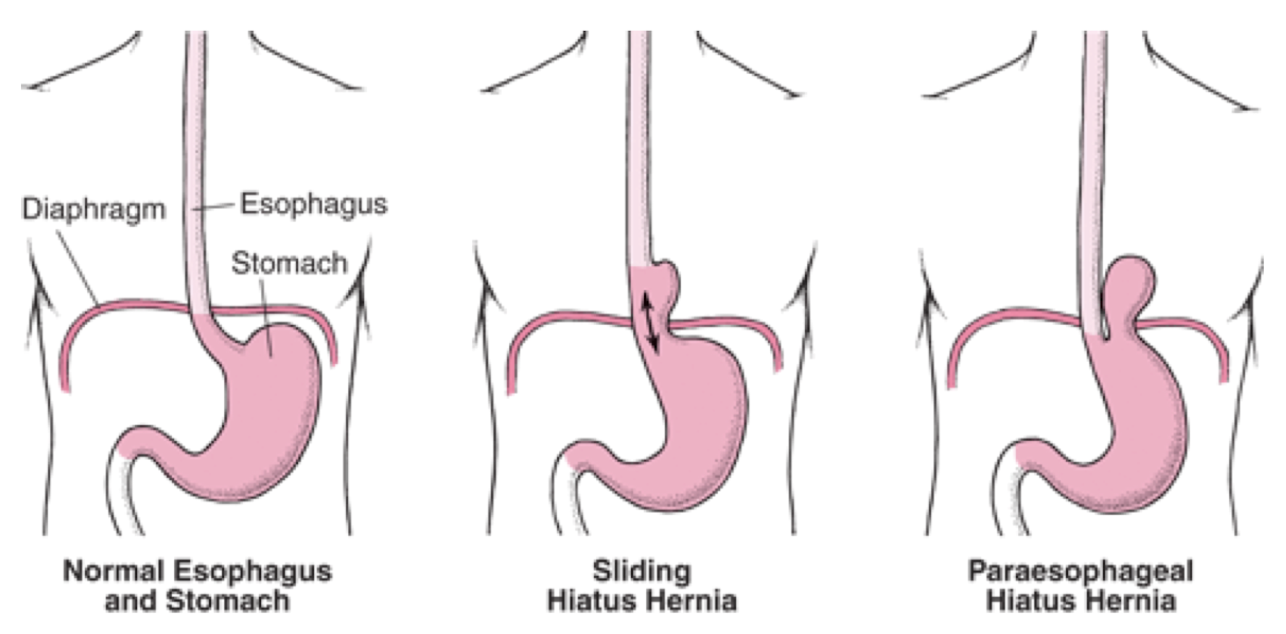
Sliding Hiatal Hernia
The more common of the two hiatal hernias, on the gastroenteric (GE) junction above the diaphragm. Risks include:
- Higher adiposity.
- Pregnancy.
- Chronic straining.
- Coughing.
Paraesophageal (Rolling) Hiatal Hernia
The less common of the two hiatal hernia, when a portion of the stomach rolls-up beside esophagus and through the diaphragm. This can begin a cascade whose steps include:
- Herniated stomach becomes compressed.
- Compressed tissue becomes inflamed, increasing compression.
- Compression leads to ischemia.
- Ischemic tissue becomes necrotic.
- Stomach contents leak into the peritoneum.
- Infection of the peritoneum.
- Peritonitis.